Scion presents Breaking Through - Submit an artist today
RA: Resident Advisor Global
News
Features
The Feed
RA Newsletter
Local
Event listingsSubmit an event
Club Tickets
Party photos
Clubs bars and venues
Music
Music reviews
DJ PagesDJ Charts - Top 10s
Record labels
RA Podcast
Interact
My RA
Inbox
RA ForumsLatest forum topics
Competitions
Search RA
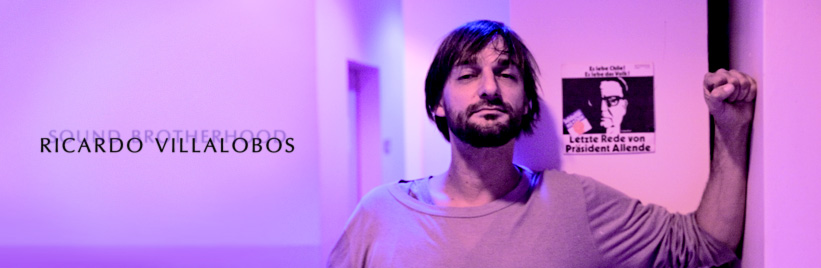
Ricardo Villalobos: Sound brotherhood

One of the most inventive producers in electronic music has only one thing on his mind: Sound. Todd L. Burns talks to Ricardo Villalobos in advance of his appearance at Movement Torino later this month.

Talk to Ricardo Villalobos, and the conversation will inevitably come back to one thing: Sound. Villalobos is obsessed with it. The highest quality speakers, using every frequency available to him in his productions, celebrating those who share his passion for audio fidelity. He is a rarity in the modern age: A man who not only talks about the limitations afforded to music made with Ableton and listened to via laptop speakers, but one that is also actively doing something about it.

Yes, Villalobos has a privileged position to do so. He's one of the world's biggest DJs. But unlike many of his peers, the myths about him are different. It's not the distractions—the interviews, the photo shoots, the behind-the-scenes behavior—that are mentioned. It's the stories about him spinning jazz in Room 3 at fabric or playing records backwards at Cocoon in Amnesia. It's the sort of tales that focus around the sounds coming out of the speakers.

That music—his own, especially—has been celebrated from all corners. And it may soon get even broader. In a recent interview, Villalobos talked about transitioning out of dance music in the next ten years, and focusing on things like jazz and soundtracks. His current project, for example, is in collaboration with Max Louderbauer and will feature them working with elements from the catalog of the jazz label ECM. When we caught up with him in his Berlin studio a piano trio played softly from his speakers as we chatted about back-to-back DJ sets, Sei Es Drum and, of course, sound.


Villalobos at fabric
Villalobos at fabric's 10th birthday
I wanted to ask you first about the documentary about you that recently premiered in Venice. Why did you decide to do it?

The director of the film, Romuald Karmakar, is probably the best documentarian in all of Germany. So if someone like this is asking you to do a film—a serious observation about what is happening—then you can't say no. [laughs]

Speaking of film, I recently saw an interview with you where you talked a bit about eventually transitioning out of dance floor music into other areas, including soundtrack work. Have you done much with this already?

Berlin: Symphony of a Big City is one. It's a movie from 1927, and we made about an hour of new music to put underneath. That was very nice, and now we are doing music for another movie from a local director.

Do you find yourself working differently when doing work like this?

No. It's the same approach. Working with pictures is of course another challenge, though.

Did you feel like you needed to challenge yourself?

Of course not. I feel like this every morning. [laughs] It always has to be a challenge. For me, my biggest challenge is to reach the sound quality of acoustic recordings with electronic instruments. That's why I have the modular system and things like that. The goal is to use all frequencies, the whole range.

Electronic music is still far away from acoustic recordings, the guy behind the instrument, the guy who has played for 40 years, the guy who is mixing it all, the placement of the microphones, everything having a history. Like a jazz recording. [turns on stereo] There's an incredible room, an incredible atmosphere in a pure analog recording. It's amazing. Every day, that's my goal. To reach this richness.

That should be the target of every electronic musician, because the sound design of putting the frequency here and this frequency there—to separate all frequencies. It's the only thing we can do. It's our expression.

You talked quite a bit about sound quality when you were doing interviews around your Fabric CD. Do you think that things have gotten better since then?

No. I think the development is going in the opposite direction because everyone is making tracks in programs like Ableton, which has an OK sound engine. When I started making music 20 years ago, you had to at least buy a mixer, then some synthesizers, a drum machine—which is the best quality possible of a sampled drum. There was a pureness of the source of the music. It was analog, direct. Now you have millions of sources, millions of programs and especially these few programs like Reaktor or Ableton that are complete. They have all of these virtual instruments that are calculated by a computer, and you have a certain space where you have to put everything. And when you want to leave this space, you have to live with compromises, the compromises of digital mixes and recordings.

Everyone at the moment is thinking these are good things. Especially at the moment with labels disappearing and all of the people that once helped decide whether a record is coming out or not not—the label manager, the friend of the label, the designer—are going away. People are finding it easy to publish something without any controls. And this is the problem with the internet in general. There is so much information, and no one knows if it's true or not. It's just there. It's an information monster.

Why do you think, with the infinite possibilities afforded to them, that producers don't reach outside these programs?

The thing is, you have the limitation of the program, the limitation of the digital mixing which is happening inside the computer, you have the limitation of the sound sources of the synthesizers—the virtual synthesizers. Even the sound engine is playing a very big role in the whole sound of the product. If you have a good turntable and good speakers, you can hear it is made in Ableton. Logic, for example, is very neutral in sound but Ableton...you can hear it in two seconds.

Ricardo Villalobos selecting records


RV
Reboot recently put a track out on Sei Es Drum. I've heard that there's a very interesting story behind it. Can you tell me a little bit about how you came to put it out?

All of the records that come out on Sei Es Drum come out because they have to come out. The stuff that comes out on the label doesn't have to be high electronic product. It is product for the people, for everyone. We are playing a lot of tracks before they are published. Most of them are not published, in fact. We have a net of friends, some Romanian DJs, some German DJs that have these tracks and play them out. And then suddenly it's clear that such and such a track has to come out. This track is necessary.

The Reboot track was done when he was in South America. He met with some of my friends in Sao Paulo, and they gave him a CD of Brazilian folk music. One of the songs was written by an Uncle of mine— Geraldo Vandr—he was married to the sister of my father. It was a protest song in Brazil against the dictatorship in power; he went to jail after playing it. A Brazilian named Simone was the first person to sing it after a number of years, and while it was a bit risky for her, she did a cover version. It was during a TV program, so the recording isn't very good but it has a lot of the atmosphere.

Reboot got this track by coincidence on the CD, and fell in love with it and made a track with it in Argentina. Two days later we met in a hotel in another city in Argentina and we played each other some tracks. When he said that my friends had given him this CD, and that he had made something, I knew that it was this one.

So we began to play this track out, and it was always devastating. But we couldn't bring it out because I couldn't find a contact for my Uncle. (He separated from my Aunt, and she had died ten years ago.) But we decided to release it anyway. I put his name on it, and now we are finally sorting out the financial stuff. The label, though, is not something we do to make money. Putting vinyl out these days is a romantic thing. Otherwise no one would do it anymore.

On the other side of that vinyl, there's a track with you and Jorge Gonzales. He's someone that you've worked with quite often recently. When did you first meet him?

In 1993.

By then he was a huge pop star in Chile.

He still is one. Whenever he plays there, he'll play two or three days to stadiums that are completely full.

What is it like working with him?

Very special, hyper-intelligent. Very spontaneous, super creative. It's very nice to work with him, and it's a challenge too. I love his voice.

Why is it a challenge to work with him?

Because it's always a challenge to work with someone that is doing something very well, and has been doing it for the past 30 years. He has this certain connection to everyone—certainly in South America, because he is such a huge pop star.

"I could play alone, but when
you have more point of views,
the party becomes more colorful."


Do you find it strange to have this extra-musical content added to your tracks, do you worry about it?

No, not at all. For me, the idea that electronic music is not political is bullshit. Every movement—if it's more than two people—is political, in a way. Every common interest where there is a connection, is a political thing. And you have a political responsibility. The sound, the artistic approach, the content of text, if you play a siren in your set, some Arab preachers, some classical music from Bach, it will all polarize the dance floor in a second. All of these things are political.

Do you have non-productive moments in the studio? Do you get writer's block?

Of course. But then I listen to music. For me, this studio is my escape from all responsibilities. The stress outside, this compressed world. If I'm not recording something, then I'm listening to music.

Are you listening to a lot of electronic music in your off time?

No. If electronic music is interesting, then of course I listen to it. But compared to everything else, it's not very inspiring. To listen to inspiring electronic music, you have to meet the person, then you have a different approach to the music, then you have a very nice situation sometimes after a gig at a private thing, then you have a nice approach to electronic music that is beyond the dance floor. On the dance floor, all you listen to is dance floor-related music. Most of the time, you play with some very interesting friends, and there is a big exchange of music. But in private, I listen to more classical and jazz music.

Ricardo and Richie back-to-back
Ricardo and Richie sharing the stage at Dancevalley, 2005
You mentioned playing with friends. You play back-to-back with tons of different people.

I love to. Every time I have a discussion about the back-to-back thing—Of course it's different to play back-to-back than it is to play alone. When you play alone, you have your 20 next chess steps, but it's a different approach. Back-to-back means you share a nice situation.

I love to play back-to-back in closing parties, opening parties, special parties, after hours. Because you're in this special situation, and why shouldn't I share it? Because I'm the stupid big DJ and everyone wants me to play alone? I've been playing alone for 25 years, so I think it's stupid not to share the situation. Some people come up to me and say, "Oh, you're a little bit more lazy now." But that's absolutely not the case. Of course I could play alone, like always. But the back-to-back thing is like playing in a band. And when you have more point of views, the party becomes more colorful.

Who surprises you the most when you play back-to-back? Who is pulling out records that you don't know?

Zip, of course. The Romanians—Rhadoo, Raresh, Pedro—because they are studying all the time. They bring out new things from old times that I never knew the first time. For party situations, Luciano is quite nice. But it's more like a brotherhood thing, delivering this joyful attitude. It is supposed to be surprising all the time, though, otherwise you lose interest.

With Richie [Hawtin] it was super nice at the beginning. Especially when we had a different approach, and we would meld this together. In some situations, it would be divine. But sometimes it was also a very artificial situation. We had to play together, blah blah blah. But, you know, he's making technological steps with his gear and his things and I'm still playing records. So sometimes this synchronization between the computer system and the records [was difficult]. We were scheduled to play together at Robert-Johnson the last time, but I wasn't able to make it because someone stole my records. It's always interesting to play with him, though.

I recently talked to some people at fabric, and they said that you were among one of the first DJs to take advantage of the soundsystem. What do you think they meant by that?

I don't know, of course, because I wasn't there for the context. But the thing about fabric is that it's one of the few clubs that you go to, and when you first walk in, you realize the sound is the biggest instrument you can use in the club.

There is a guy that goes around measuring the average feedback frequency of the night. He will come back to the stage, press a button and the frequency will disappear—and there is no feedback anymore. It's the best sound I've ever heard in a club. When you go there, the motivation to play all sorts of different things is there immediately.

Obviously Cocoon at Amnesia has that motivation for you as well.

Of course. Inside the limits of Ibiza—which means restrictions, fights between the different disco Mafioso—it's amazing. Every Monday you have six or seven thousand people, and you're standing there like a little child at the end of this tube. You receive such an energy flash in your body when you play there. For every DJ, no matter how long you've been playing.

You still get that?

Every time. But it doesn't just happen to me. It happens to everyone that plays there. In Japan, there are many clubs of high quality. And Barraca in Spain too. It's a 43 year-old club that has been through many different generations. It's the best club in Spain, even though it faces all of the restrictions, like in Ibiza. And then there's Berlin, the sound in general has this rotten industrial-grade holes, so the sound is not very good overall. The Berghain has a very good sound, because of the very high ceilings, and the speakers are very concentrated. It's the opposite in Panorama Bar, where the sound is very reflective. The room is most important for sound, then the speakers. Role 20 or so is the DJ. [laughs]
Published / Fri, 23 Oct 2009

comment 185 Comments

Photo credits /
Ricardo at Fabric - Nick Ensing
R2R - Merlijn Hoek


Features


Other recent features
DJ Bone: True to da rootsSebo K: Safety firstBreaking through: Sleigh Bells

About  
RSS feeds  
Get involved  
Submit event  
Copyright © 2009 Resident Advisor Ltd.
All rights reserved. Terms & Privacy.