Breaking through: San Proper
He's been a stalwart of the local scene for years, but with a hit single on Perlon, Amsterdam's San Proper is finally making waves in international waters.
Anyone who has frequented Amsterdam's nightlife over the last decade has likely stumbled upon San Proper at some point. And anyone who has met this colorful character agrees: San is driven by a fiery passion for music and an innate predisposition for eccentricity. He's the type of person you'll find playing a marathon set at a hazy after hours, where all that's left of the soundsystem is one working record player and two crackling speakers. Putting on one dusty gem after another without mixing, he'll be grasping your arm repeatedly, pointing at the ramshackle stereo system: "This is my favorite record of all time!" And even though he'll probably claim the same about every other piece of vinyl that he spins, you know he's completely sincere about it each and every time.
He's been at it for nearly 15 years. Between obsessively promoting different nights and fulfilling DJ residencies at clubs and cafés across town, you have to wonder when he finds time to sleep—or make music. In fact, his crazy lifestyle probably did lead to the postponement of his debut. But when it finally came out, his Proper A'dam Family series on Rush Hour caught the eye of Laurent Garnier, Ricardo Villalobos and Zip. Each heard something special in Proper's music, and each have since offered their support: Garnier made an edit of Proper & O'Boogies "Magnificent Speech Funk," Villalobos invited San to remix a track on his Vasco EP and Zip signed him to Perlon.
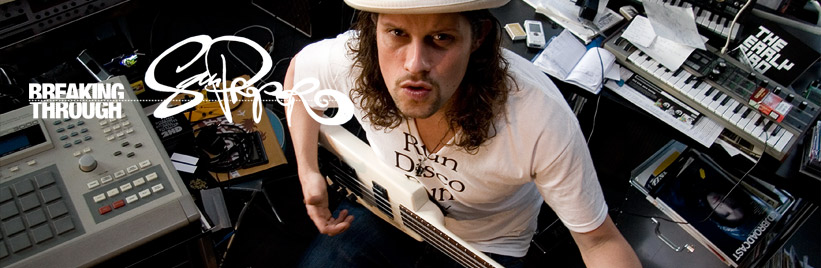
San's living room/bedroom/kitchen/studio (all in the same tiny room) is only a stone's throw away from the Rijksmuseum, in what is best described as an upscale version of the Red Light District. This isn't where British tourists come to spice up their stag parties. It's where family men from the richest part of town have their depraved little evening strolls. It seems appropriate for San Proper's studio, a place that has been responsible for dark-sided deep house and twisted techno. "Hupsers & Kletsers For Life," "Keep It Raw" and "Magnificent Speech Funk," three of his most celebrated tracks thus far, are specked with uncharted corners and puzzling little secrets. That said, the studio itself is actually sunny and quaint. Even though it's stacked to the ceiling with peculiar instruments and piles of records, it's an extremely comfortable place. This probably has a lot to do with San's warm personality: As we meet up for the interview, the first thing he does is cook us some lunch.
"My first serious encounters with music were deeply linked with the first time I fell in love," San recalls. "From then on, music always had a great sentimental value for me." When he was ten, San was inspired by The Specials, Sam Cooke, Otis Redding, Lou Reed and Professor Longhair to pick up a guitar. An '80s TV course called Rockschool further encouraged him to be in a band. "That program really inspired me to have a do-it-yourself punk attitude." He taught himself how to play a bunch of different instruments and soon joined his older brother in a band called How Could She. "They used to play songs in many different genres. I learned a great deal in that period of time, soaking up various styles and having my first encounters with songwriting." In high school, San had but one dream: to be the greatest and most original guitar player who ever lived. And moving from band to band, he was actually well on his way to national fame. In 1999, San won the most prestigious pop talent accolade in The Netherlands, The Grand Prize, as part of the funk band The Mindmenders.
But even with so many opportunities at hand as part of The Mindmenders, San didn't shy away from following his own path. Only months after they had won The Grand Prize, he left the group. "At the time I simply identified more with being a DJ and a producer than with being a guitarist in a band." He had already experimented with different types of electronic music production, imitating drum sequences on a little sampler and composing various tracks with a friend under the moniker Marinos Santos. "At the time I was influenced by many different types of music. Through labels like Ninja Tune and Warp I got turned on to electronic music. Other great inspirations at the time were Les Rita Mitsouko, Sylvester, Bohannon and A Certain Ratio. Inevitably I got into house and techno." San approached DJing in the same way he had played instruments. Without any real practice or any decks at home, he started spinning at bars across town, gaining gigs and residencies along the way. "Every DJ knows you only need a year or so to be reasonable at mixing," he shrugs. "It's really all about persuading an audience to fall in love with your favorite records."
What followed was a nocturnal roller coaster that would last nearly a decade, in which San was living the DJ life to the fullest. Moving from bar to bar, from club to club and from after hour to after hour, there was rarely a night or morning where you wouldn't find him snug behind the decks. He didn't make it easy for himself, though: When everyone was playing techno, he was promoting deep house with his Choque club nights. When minimal was ruling Amsterdam, he established The Black Disco Bust. And now that house is dominating dance floors, he's started an Italo disco night Italo Elite with his buddy Tom Trago. "I used to get complaints from some promoters, who would ask me things like: 'What are you, a techno DJ, a disco DJ or an eclectic DJ?' But I've never really had a certain brand or marketing strategy. The only way I've ever tried to sell myself is with my soul, with who I am. Hopefully people can recognize that in the things I do."
In an effort to showcase himself further, San turned to production. He began with the Proper A'dam Family series on Rush Hour in 2007, in which he collaborated with friends from Amsterdam like Steven de Peven (Rednose Distrikt), O'Boogie and Trago. "I wanted to first show where I was coming from, before I would exhibit myself as a solo artist." Even though the A'dam Family series were all limited editions, they certainly reached the right crowd: "[I was] getting props from people I had always respected, like Anthony Shakir, Ricardo Villalobos and Laurent Garnier. Soon enough I was asked to do a remix for Villalobos, and Garnier had made an edit for me and O'Boogie for Rush Hour. Things really started to take shape then." Right now San is busy completing remixes and has just released his first solo track on Perlon, "Keep It Raw," which was honored with a #1 placement on Groove's recent charts.
It's been a long time coming. But to San, who feels more determined about his musical identity than ever before, this is somewhat of a blessing. "At times I thought I should have focused more on producing at a younger age, but in the end I'm happy for having taken the time to develop my own signature sound. Besides, it's better to drop something decent after ten years, than to drop something half-decent after five." To make sure his dark and twisted take on house sounds is as authentic as possible, San uses an array of self-recorded sounds. "All the drums I feature in my tracks are either tape recordings from real drum machines or live recordings from some of the percussive instruments I've collected over the years." His studio is strewn with strange looking musical devices—a Brazilian agogo, a traditional cuica, an African kalimba. "I sample my own bass and my own keys, and I also use my own vocals a lot. All these elements help in forging a sound that's truly your own."
With house and techno as his focal point, San continues other musical endeavours under different monikers. His Stepmother alias is meant for female-friendly dubstep and St. Propre is reserved for his Holy Edits—disco cuts like the one that recently saw the light of day on Jé Davu's Raw Meat imprint. Disco music has always played an important role in San's life. "In the mid '90s there was a revival with the sound of the French filter house. And then disco was proclaimed deceased. But for me disco never died, and it really never will." He grins: "Maybe it has something to do with my birth year being 1977. I started promoting The Black Disco Bust for the first time in 1999 at Mazzo in Amsterdam, simply because no one else did and I really felt obliged to represent underground disco classics again. The night has been successfully running for a decade now. You can sense that the music is making a comeback. It's great to hear the echoes of disco even resounding in the minimal scene these past years, where deep house and disco have been totally embraced now."
Some media have positioned San as part of a new Amsterdam house generation. "I feel a great deal of respect for all the guys from Remote Area. Most of them are my homies, and I think they're very representable of the Amsterdam sound, even though I don't feel like I belong to their 'generation.' I take most of my inspiration from friends like Melon, Tom Trago, Steven de Peven and from the Rush Hour crew, who have kept the city big for such a long time. I think Dekmantel deserve a big round of applause for the vibes and the sounds that they've been spreading."
San has a good feeling about the city as a whole: "Bitching about the local scene is probably a common thing in every town. And Amsterdammers are renowned for complaining. And sure, the local policies on closing times and small clubs could be a lot better. But opening hours and spots aren't the factors that determine the sound and the vibe of a city. Amsterdam has always had a special vibe to it, regardless of any change in laws or clubs. But I wonder if it's any more special than the next town. Whenever I'm booked abroad, I try to stay a couple of days to soak up a city's atmosphere and I always come across something fresh, interesting and inspiring."
Dekmantel is taking care of San's Dutch bookings these days, and will be bringing out a new EP of his in January. Then Perlon will again be the center of attention, starting with a track on their upcoming Superlongevity compilation. San is determined: "It has to be raining releases this next year!" Also, he wants to get his live show on the road. He began that process with a debut performance at ADE which featured his laptop as a base, spiced up with his bass guitar, pieces of a drum set and more live instruments.
Performing and producing are the two elements that keep his life in balance at the moment. "Lately, I've really had to learn how important it is to be a homebody, instead of being constantly on the move. During the week I stay in, producing, but on the weekends I need to go out and be on stage. Not just because it's my job, but because I have certain exhibitionist cravings inside me that will probably never calm down. This balance between the studio and the stage has become essential for me. It's part of my personal cult."
Whatever the future holds for San, he knows he'll be making this music for years to come. "Recently I was listening to a mixtape I did more than ten years ago. I was surprised that the sound was a lot like the sound I play these days. And it will probably stay the same within the next years, only refining as I go along. Sure, I hope to do different things too, but the core of this sound will always be the same, because it represents everything I experience, and the subculture of which I'm a part."
| | |