Scion presents Breaking Through - Submit an artist today
RA: Resident Advisor Global
News
Features
The Feed
RA Newsletter
Local
Event listingsSubmit an event
Club Tickets
Party photos
Clubs bars and venues
Music
Music reviews
DJ PagesDJ Charts - Top 10s
Record labels
RA Podcast
Interact
My RA
Inbox
RA ForumsLatest forum topics
Competitions
Search RA
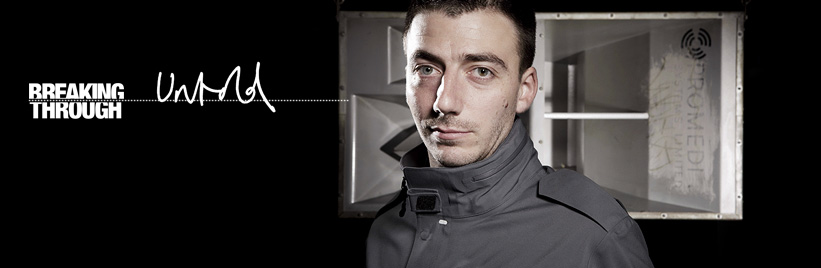
Breaking through: Untold

The Hemlock Recordings boss is finally making waves after 15 years of experimenting with production. We catch up with Jack Dunning to find out why he's breaking through now.

If you have yet to be impressed by Untold, you must not have been paying much attention to bass music in 2009. Last year's "Yukon" was a warning shot, its fractured beats picking up where rhythmically adventurous productions like Peverelist's "Infinity is Now" left off. Then came this year's "I Can't Stop This Feeling" which sounds like grime pushed through a kaleidoscope.

On the other side of the same Hessle Audio 12-inch was "Anaconda," whose fresh production techniques and slap-in-the-face bass stabs saw it caned by everyone. Including those who could care less about "experimentation." Released around the same time, the restrained, house-influenced vibes of Sweat/Dante thickened the plot further. How had a producer with so few records under his belt been able to tweak the DNA of so many styles so quickly? And more importantly, how had he been able to do so in a way that maintained his own sonic calling card so well?

Part of the answer seems to be that practice makes perfect. The man behind the beats, Jack Dunning, has been experimenting with production since 1993, in the early days of jungle. He credits Tempa Allstars Vol. 1 with giving his production studio tinkerings a new impetus. In his words "I had my head up jungle's arse for 15 years, and then went to DMZ." Untold has become an influential producer, and has earned the respect needed to play the coordinating role of label boss—Hemlock Recordings—because of longtime dedication and a sensible outlook. What seems to have been a sensationally quick rise to prominence has really been more like the decanting of a long-maturing bottle of wine.

And for the future? Jack says, "I hope dubstep continues to be hard to pin down, disobeys its manifesto, gets called stupid names, gatecrashes other scenes and spikes the punch, elopes and has lots of children."

Untold on the floor
You recently wrote on Twitter: "Chirpy Heathrow passport officer: 'That was a short holiday.' Me: 'I was DJing.' Him: 'What sort of stuff do you play?' Me: 'I don't know anymore.'" Seems like a good place to start. Could you go on?

He looked a bit disappointed after that. Hater. The other day after a gig someone came up and said "I thought you were going to play dubstep," and I was like, "I thought I did!"

In an hour-long set I'll drop tunes that sound a bit like grime, or Baltimore, or deep house, or tribal techno. A couple of them I haven't got a clue what they sound like. I'd rather play it slightly schizophrenic and disjointed to showcase how wide dubstep reaches, than play a well-tuned purist's set.

Dubstep is more palatable and easier to market if it follows an accepted template, but that was never what it was about. It was about building a new sound, or even just putting old sounds in a new context. That sense of exploration is still strong, but it's sometimes hard to hear over the noise. It's influencing and breeding with house, techno and drum & bass and more than ever it's just the tempo and the emphasis on bass that define it.


A lot of the music now being called dubstep is really closer to garage, 2-step, even house. Where do your tunes fit in amongst those styles?

I suppose my recent tracks have a lot in common with house, or to put it another way—I've taken a bunch of US house clichés and thrown a different beat under them. I've also been dropping the tempo a bit to open up more possibilities for mixing them with other styles. It's still dubstep to me, though. At least with that label it gives context to where the tunes have evolved from.

I've heard before that you come from a firmly drum & bass background. For me, it's been traditionally more about house and techno. What is it about dubstep and its offshoots that makes it so appealing to so many musical camps?

The tempo helps. It sounds ambiguous. Depending on how you program the drums you can make a tune bump along like deep house, give it some garage swagger, even match the pace of drum & bass. It appeals to producers because it's always been about experimentation rooted in the dance, and serves as a reference point to collide various musical influences.

The dances are usually free of attitude; generally more people are there for the music than just to get mashed up. As long as dubstep stays more than just functional rave music then it'll continue to move forward and stay exciting to be involved in.

A lot of the most creative bass music right now seems to be a response to what is solidifying as the conventional dubstep sound. What is right about that sound at present? What's wrong about it?

I'm not going to lay into the scene. Visit any dance music forum and you'll get a picture of what people deem worthy or blasphemous. What's right about dubstep? It serves as a shorthand label for exciting bass music in many forms. What's wrong? Some of it's boring. That said, I think even the safer, more orthodox tunes are helping push the sound forward, as producers who want to be heard are forced to write more extrovert material.

Fair enough. Then again, you've watched jungle and drum & bass develop from almost the outset, right? Are there lessons from the development of those styles that dubstep should learn?

Making mistakes is all part of the fun though isn't it? If you were to try and protect something as abstract as a dance music scene, it would become restrictive. Let's not have any responsibility or council. Let's just go and play. As a producer I won't re-use the same sounds or rely on a template for year after year, and as a label owner I won't release throwaway music. As a punter I'll remember to have fun and dance.

Seems like a good place to take a step back from all the deep questions! Could you tell me a bit about your own personal history as a clubber?

I started pretty young, and got to hear hardcore morph into jungle at various raves. Most of my mates at the time were into acid techno so I also got dragged to some nights at the Fridge and club 414 in Brixton which I found really dull. After that it was Metalheadz at The Blue Note which was a huge inspiration—I don't think I've heard music mutate as fast since then. I've also got fond memories of Swerve at The Velvet Rooms and Renegade Hardware at The End.


untold


Your DJ name hints that innovation is important to you. Have you found a sound you're happy with?

At the moment I'm messing about with US house sounds: the strings, pads and chord progressions—and putting them alongside beats similar to old grime instrumentals. I'm into that at the moment because I haven't heard the two sounds combined before. My current influences are pretty obvious, although I can see the novelty wearing off. It's not infinitely sustainable. I'll be looking to find another group of sounds or formula for a new batch of tunes. I'd like to keep updating my sound.

Even if they are a bit obvious, could you still tell me a bit about your biggest influences musically?

I'm really feeling Paul Johnson, Lil' Louis, Green Velvet, Theo Parrish, Derrick May, Robert Hood. I'm playing catch up with 20 odd years of house and techno and that's influencing my music in a big way. I don't have much baggage when it comes to nicking a vibe and throwing it alongside a dubstep beat. I think I'd just discovered the Rhythm and Sound album when I wrote "Dante." Guys like Joy Orbison and Julio Bashmore are already blurring the lines between house and dubstep—watch those two!

That bit of rudeness to the music that's traditionally quite important here in the UK—the fine art of the shockout—seems like something quite important to much of your music.

That's a nice way of putting it. If I make a tune for the dance I try and give it a bit of attitude. I've done a couple of polite chin-scratchy releases, so I write the rowdy ones to take the piss out of them—to get a bit of balance. At the moment I want to make people screwface, shout, dance weird.

Do you often imagine the effect your tunes will have on the floor as you write them? Are there any other ideas that you tend to focus on when you're making tracks?

When I start writing it's about going in and getting a loop that's strong enough to carry a tune for five minutes. It's got to have something that I haven't heard before (or at least recently), and if I jump out of my chair and start dancing that's usually a good sign that something will work in the club.

Once I've got a stable idea I'll try and plan a suitable arrangement, I'm thinking about what's going to make people react at various points along the tune, thinking about how DJs are going to mix it, whether it needs another section or a donk.

Untold a Gogo
If you don't mind my saying, the bass in your music tends to be very tightly controlled, and is a far cry from the expansive basslines of someone like Loefah. How do you know when the bass is just right?

Only when I've heard it on the Plastic People sound system. I'm not sure my bass is that tightly controlled though. Sometimes it's a bit too loose. Loefah is the master of bass. He is bass. I write all my tunes at low volumes with my finger resting on the woofer of the monitor. The vibrations let me know how the bass is going to sound when it hits me in the chest on a good rig.

Also on the subject of production, I wanted to follow up on a comment you made in an interview with Martin Clark. You said then that "dancehall riddims like 'Diwali' where the kick is tonal" have excited you recently. Can you tell me a bit more about this, and how it's affected your music?

Diwali was a big riddim that came out around 2002 that loads of people went on—Sean Paul, Lumidee, Bounty Killa. The instrumental is driven by a bass stab that sounds like a kick drum but is also in the key of the song, so it kind of acts as the bassline. I was checking some of those versions recently along with some grime instrumentals like "Pulse X" by Musical Mob which do a similar thing but are a bit ruffer. I thought I'd build some tunes using the same technique and see how it sounded. Traditionally a big part of a mixdown is getting clarity between the kick and bassline as they share the same frequency range. Combining them is a bit restrictive melody wise, but really opens up the track making it easier to get a clean mix. It also sounds rude over a system.

I recently had the pleasure of hearing Ben UFO play James Blake's remix of "Stop What You're Doing" on a big system. I didn't know what was going on. How did you hook up with Mr. Blake? When can I get a hold of that record?

We first heard James' tune "Air and Lack Thereof" (which came out on Hemlock 004) on Distance's new talent show on Rinse. We got in touch with James through MySpace and were amazed that the tune wasn't already signed. It's a privilege and a thrill to release someone's debut who you know is going to go far. That guy has an amazing voice, makes sick beats and plays piano. We didn't commission the "Stop What You're Doing" remix, it just dropped in our inbox. That was a good e-mail. It should be out in mid-October on a 10-inch backed with a Pangaea remix of "I Can't Stop This Feeling."

Can you also tell me a bit about the artwork for Hemlock?

I used to work for a branding agency. Andy, who I co-run the label with, is a very talented print and exhibition designer. We knew we could do something nice—it was just about finding something that would stand out, be durable and most importantly cost-effective. The sleeve design is a modified Renaissance wallpaper pattern. How much more road can you get?

"I just want to make honest,
original sounding tunes that
people either love or hate."


Do you think wearing these two hats, producer and label head, is a good thing? Does one complement the other?

It's nice to have the freedom to put out my music, although I'm glad I co-run the label as sometimes it's hard to be objective about what to release. Running a label occasionally takes away some of the innocence of knocking out a beat. I have to remind myself tunes are tunes—not products—and try not to think about whether it's going to sell (or even come out) when I'm writing.

London is certainly incubating a lot of very creative producers right now. What's your take on the music scene there? Is there a geographical influence on the sound?

FWD still holds the scene together here. To have those lineups on that sound system every week is a blessing. There are a couple of other nights like Medium (also held at Plastic People) that play dubstep alongside techno, hip-hop and drum & bass which is great. We're doing alright for big clubs—Fabric, Matter, Cable etc.—but it would be nice to have a few more smaller venues with quality sound. London has always been good for innovation, but I don't think location plays such an influential role these days.

It's been a very productive year for you already, and I've heard Hemlock 005 will feature a lot more of your music. What's brought about the spate of productivity?

The tunes on the new EP only contain a few elements—bass, percussion and some chords—which make them quicker to write. They were all written within a few weeks, a couple of them on the same day. I think that spontaneity comes across on the EP which I'm pleased about. I'm also obsessing less over the details and trying to focus on ideas that are easy and fun to execute. I think some of my earlier releases were a bit fussy and lost some of their charm because of over-preening. Gone are the days of staying up until dawn getting an edit right. I just want to make honest, original sounding tunes that people either love or hate.
Published / Mon, 19 Oct 2009

comment 15 Comments

Photo credits /
Header, Untold on the floor, Three Untolds - Duncan Nicholls
Untold at Dubstep a Gogo, Utrecht, Netherlands - Rosa Maria Koolhoven


Features


Scion Audio Visual
Scion Radio 17
Scion Radio 17
Other recent features
DJ Bone: True to da rootsSebo K: Safety firstBreaking through: Sleigh Bells

About  
RSS feeds  
Get involved  
Submit event  
Copyright © 2009 Resident Advisor Ltd.
All rights reserved. Terms & Privacy.