Scion presents Breaking Through - Submit an artist today
RA: Resident Advisor Global
News
Features
The Feed
RA Newsletter
Local
Event listingsSubmit an event
Club Tickets
Party photos
Clubs bars and venues
Music
Music reviews
DJ PagesDJ Charts - Top 10s
Record labels
RA Podcast
Interact
My RA
Inbox
RA ForumsLatest forum topics
Competitions
Search RA
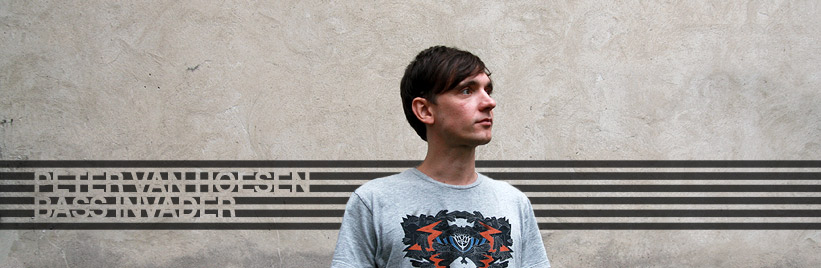
Peter Van Hoesen: Bass invader

The Belgian producer has some of the dirtiest basslines in the world of techno. RA's Richard Brophy called up Brussels to find out more about the rising DJ/producer.

You know that moment when you can feel that a producer has nailed a sound that they had previously only hinted at? That's exactly the way I felt when I heard Peter Van Hoesen's "Trusted." I had come across Van Hoesen's music before, but in truth, "Trusted" had piqued my curiosity only because it included a Norman Nodge remix. That version quickly fell by the wayside, however, as the cavernous, grandiose bass of the original version unravelled, amid austere and ominous synths. Trusted and its follow-up, Casual Care—both on Van Hoesen's own Time To Express imprint—are underpinned by a grimy, flawed sensibility that proved irresistible.

Unsurprisingly, bass has played a central role since the very start of Van Hoesen's musical journey. As an 11-year-old, he learnt how to play the bass and keyboards after watching a fateful television performance by '80s Belgian act Telex. "It was the first time that I had seen a band playing on stage with huge synths—I was fascinated by what I saw," he explains. Other local developments shaped Van Hoesen's teenage experiences: The emergence of New Beat during the mid to late '80s, an almost uniquely Belgian pre-acid house dance floor sound, also caught his attention: "The music had an obsession with bass, even the faster tracks were pitched down. For people of my age, my generation, in Belgium, New Beat is still important and I still like to play slower sets, you can feel the space between the beats and bass."

A Split Second - Flesh

Beat Dis: Peter Van Hoesen's Top 5 New Beat Records

A Split Second - Flesh (1986)
This is the proto New Beat track as far as I'm concerned. DJs played it with the pitch way down, so the track would acquire a very particular grinding, bassy feeling. Essential.

Snowy Red - Euroshima (Wardance) (1988)
This track sits somewhere between electronic New Wave and New Beat. It's dark and dystopian synth pop, like Telex on a bad trip.

Public Relations - Public Relations (1987)
I remember one particular Wednesday afternoon, walking around in Antwerp and hearing this in almost every shop I visited. Even the bigger radio stations would play this tune, it's one of the more accessible examples of the genre.

Neon - Voices (1998)
Nowadays this would probably be labelled as Minimal New Beat or something similar. It's pretty straightforward, but has all the right ingredients: a spooky synth melody and drums relentlessly banging away. It's in my record bag, I'm still waiting for the right moment to play this out again.

Major Problem - Acid Queen (1988)
This track was filed under "Acid New Beat," and I guess that's appropriate. Pounding drums join up with a squelching 303 and explicit lyrics to construct Belgium's politically incorrect take on Acid House.


Van Hoesen feels that there was only a year or two of good releases before New Beat lapsed into self-parody, but it left a lasting impression, and inspired him to start DJing. "After New Beat, I found Detroit techno and then that whole adventure began," he laughs. "At the time, there was nothing like it, it was so powerful, and I had no clue as to what kind of city Detroit was. I loved the basslines in New Beat and Derrick May's records also had basslines that were very important, but they were different to New Beat. It (New Beat) wasn't very funky, and that's what the guys in Detroit had, this magic formula. It was the familiar sound of the machines, mixed with the funk."

By the early '90s, Belgium had become the unofficial spiritual home on the continent for electronic dance music. R&S Records and producers like CJ Bolland and Frank de Wulf were releasing a unique version of high-octane techno that inspired the nascent rave/hardcore scene and US artists as well as emerging UK names like Bandulu and Kirk Degiorgio were making their first continental appearances at warehouse parties organised by the BWP organisation.
Having attended these parties, Van Hoesen began putting on his own events with friends. He admits that the new wave of hard-edged techno from this period "really had an impact on me," but as the decade progressed and the music veered into a one-dimensional loopy cul de sac, Van Hoesen started to get bored and turned his attention to production.

Inspired by the new wave of German glitchy minimalism emerging from Cologne, he set up the experimental/ambient label Foton, and had a number of releases as Object and Vanno. Consequently, Foton forged links with Brussels' strong visual and performing arts community and they were invited to perform sound installations. "I went totally into that direction and I didn't do any techno for quite a while," he explains. "We started to throw these really cool events where we'd start with experimental music, which we presented to an audience lying down, usually with a four speaker setup so they were 'caught' in the sound. Then we gradually took it up and changed the music into a more danceable style, whereupon we removed the cushions and had people go from horizontal to vertical, all in one night."

Foton's reputation for curating unusual events spread, and they were asked to organise parties for other people. They were the first organisers to book the then-unknown Kode9 and Spaceape in Belgium, but eventually Van Hoesen grew tired of the energy required to keep it going. "Foton was most active between 2002 and 2006—it was a big commitment and it didn't give me the time I needed to concentrate on making music," he says. "By 2006, it was also becoming more difficult to do these type of events because there were fewer venues and the support for experimental music was falling."


PVH


Despite this, Van Hoesen believes that Belgium remains one of the creative hotbeds for electronic music, and that techno is instilled in the national psyche. "On the whole, people here are well connected to electronic music. I know people who don't go out at all but still listen to house and techno at home. They carry that virus with them!" Unfortunately, he also feels that Belgians are classic underachievers. Maybe it's the fact that the country is sandwiched in between Europe's two biggest countries that gives them an inferiority complex, but even though it hosts the world's biggest techno party —I Love Techno in Ghent—and its capital is home to the world-renowned Fuse club, Peter thinks that his peers need a confidence boost.

"It's also part of being Belgian, not realising your potential," he says. "This is especially true in electronic music; there is a lot of good music being made here, a lot of talented people, but they just don't believe in themselves enough. There is a tight community around Dr Vinyl, the last record store in Brussels, and some of the music the people in that group are making has blown me away. Fuse is also one of the beacons for techno in Europe," he adds, "and in the past few years, the club has had more to boast about than ever before."

Yet despite these claims, Van Hoesen could never be described as immodest or arrogant. Softly-spoken and considered, his persona seems at odds with the brutally effective, surging basslines that characterise tracks like "Casual Care," "Empire in Decline" and "Face of Smoke." It's the sound of someone that is wholly confident in what they're doing. "By 2005/2006, I had tried every possible genre, so many musical directions—breaks, bass, dubstep—and I felt a bit lost because the music I was making just wasn't satisfying," he explains. "I asked myself what I did best, where my heart was, and the answer was techno. I had flirted with dubstep a bit, but it wasn't for me—techno is so much a continental sound and once I'd made the decision to stop making dubstep, it felt like I was coming home, but I had all this extra baggage with me that I'd picked up along the way and that helped shape what I do."

Live
Indeed, Van Hoesen's flirtations with experimental electronic music are audible on 2006's "Increments" for Lan Muzic, a release that he says was "a big deal," but his previous experiments are also evident on subsequent material—check the swinging, lurching bass on the more recent "Attribute One" if you're in any doubt that he has abandoned his varied background. At its core, though, Van Hoesen believes his music is still heavily influenced by the "golden age" of techno. "I am still inspired by the music from that period of around 1994 to 1995 and by the manifesto—you're at a warehouse party, all your friends are gone, but you are in the moment, with just a kick drum and a strobe. Sure, it's an old school vibe, but techno has a grimy feeling and for me techno is forever connected to that space and feeling."

Which neatly brings us to contemporary techno. In the wake of the recent minimal explosion and subsequent implosion, the genre seems to be reverting to classic sounds, and even adopting early '90s presentation, evident in the wealth of anonymous, hand-stamped releases emanating from Berlin's Hardwax record shop. Van Hoesen's music has been compared to this purist strain of techno, popularised by the city's Berghain club. Does he feel an affinity with Klock, Dettmann and Nodge? "The people you mention have been around for a while and realise that you have to connect to the past to move forward. They live in an environment where they are inspired by music all the time, so we have that in common and I feel connected to those people, yes," Peter replies, before quickly adding "at the same time, I hear a difference between what all of the Berghain artists do, even if they have a shared aesthetic."

While techno may have shifted focus in the past two to three years, with new school purism now vying for attention with technology-powered minimalism, and their competing manifestos trying to make themselves heard, Peter doesn't believe in the "us versus them" mentality, a battle between furrowed-brow authenticity and Cube-style gimmickry. "The older I get, the less I see the divides. It's just different people with different ways of making music," he feels. "It's hard to say that one group has a more genuine motivation than the other. That's more to do with the individuals themselves, but of course there are people in it for the right and wrong reasons. If there is a divide, let it be there and maybe the bad music will inspire producers to make great music. I know it happened to me—I heard certain techno music and I thought to myself 'you can't be serious that you're making that' and it gave me a reason to make my own music." he says, adding that when at home, "I listen to everything from Slayer to Frank Zappa."

This explains a lot about why Van Hoesen's music has struck a chord; instead of just getting nostalgic about '90s techno, his productions are laced with glitchy percussion, cloaked in layers of ambient, droning noise and while indebted to the jack-knifing relentlessness of UK producers like Luke Slater and Bandulu, also make nods to Basic Channel's cavernous echo chamber.

"I heard certain techno music and
I thought to myself 'you can't be serious
that you're making that'."


Clearly, he realises that there's a balance to be struck—after all, what's the point in copying a classic sound without providing your own interpretation or adding a unique signature? "Yes, you need to oscillate between the two—you have to be immersed for a while in the roots and then take that experience and do your own thing," Peter says. However, given the comparisons between Van Hoesen's bass-heavy warehouse tracks and the heads-down, relentless techno that is the Berghain soundtrack, does Peter feel that if he moved to the German capital he would be more successful, or is he content to be "a victim of geography" as I recently claimed and keep his distance from techno's hub? "I saw that phrase and laughed, I think I'll use it to describe myself—'Peter Van Hoesen, a victim of geography'," he says. "I don't know how things would turn out if I lived in Berlin because I live here, in Brussels; even though I was born in Antwerp, Brussels is my home. It's quite a grimy city, hectic and crowded with a sleazy edge, but it's also a multi-cultural place and a city of contrasts."

"Maybe if I lived in Berlin I might make different music, who knows, but it is one of my favourite cities, it's a great city to walk around, with those wide open spaces, a city where you can lose yourself." Peter admits that he's a "city person," citing Tokyo and Montreal alongside the German capital as his favourite cities —which means he has no problem with an increasing touring schedule that will have him playing live or DJing at clubs like Panoramabar, Tresor and Japan's Labyrinth festival.

Apart from touring, Van Hoesen's main focus for the rest of the year is his solo debut album. A format that few techno producers have excelled at, he's conscious of the pitfalls: On one hand, a collection of dance floor tracks could just as easily be released as a series of EPs, while straying too far from a signature style and trying to write songs could sound forced and ill-conceived. Van Hoesen has chosen to follow the middle ground. "I've moved the album release to next year, but I have already made four or five tracks. For a long time I wanted to make slower music, take the BPMs down to 95," he explains. "I think it'll be a varied album; I don't want a collection of 12-inches, I like the idea of an album being a story or having a narrative, it's such a different format."

Is he concerned that he may end up with an album that's neither here nor there? "Not really: The first music I released was in an album format for Foton. I only started doing 12-inches after that, so I hope it'll work out—there'll be slow, groovy stuff on it, with more space between the beats."

So it'll be like New Beat updated, with heavy, pounding basslines?

"Yes, it'll be all about the bass."

Published / Fri, 11 Sep 2009

comment 28 Comments

Photo credits /
PVH live - Hans van Houwelingen


Features


Other recent features
DJ Bone: True to da rootsSebo K: Safety firstBreaking through: Sleigh Bells

About  
RSS feeds  
Get involved  
Submit event  
Copyright © 2009 Resident Advisor Ltd.
All rights reserved. Terms & Privacy.