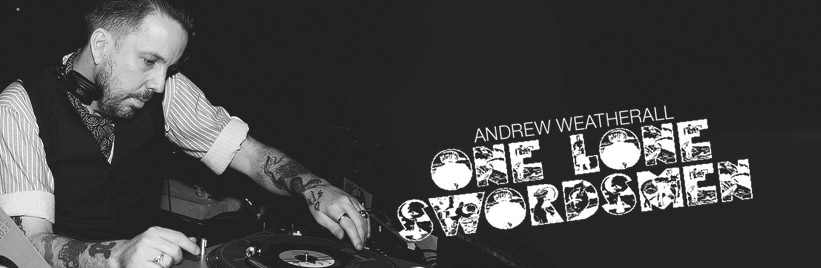
Andrew Weatherall: One lone swordsmen
RA's Todd L. Burns talks to one of the most renowned remixers and unpredictable jocks about trying to remember his own productions, warming up a room and knowing when to stop.
Andrew Weatherall is a legend. It's a weighty word, legend, but it really and truly is the only one that can accurately sum up the numerous accomplishments of the man's career. From his early days as a young hipster in the Junior Boys Own crew or his production on Primal Scream's essential Madchester document, Screamadelica, on through to his work in the '90s with The Sabres of Paradise and Two Lone Swordsmen and into the late '00s with his first release under his own name—a record which Simon Reynolds' called "his most enticing offering yet"—and all the while crafting inspiring DJ sets that span genres effortlessly, Weatherall has pushed relentlessly forward in as many directions as possible, rarely looking back take stock of his incredible oeuvre.
"It's only when I get a hint from someone else," he says. "I'll be out and the DJ will play the My Bloody Valentine remix or some Primal Scream stuff, and it'll sound really good. But I don't constantly listen to my back catalogue. I've got friends who will look at my discography and are quite obsessive. They will come into the studio, and say, 'I don't know such and such remix.' And I'll say, 'Well, to be honest with you, I can't even remember doing it'....Three or four years ago, I was in a shop in London and heard a track and was like, 'This is quite good, what's this?' It was only after the next song came in that I realized it was the first Two Lone Swordsmen album."
Weatherall's foggy memory for his own work can be forgiven. The remixes portion of his voluminous discography is by far the longest and—as far as his legacy goes—the most important. He began in the late '80s—a version of The Happy Mondays' "Hallelujah" with Paul Oakenfold was his first. And, since then, the list of artists that Weatherall has touched up, mangled, straightened out, covered and generally transformed reads like a timeline of pop, indie and dance culture: the aforementioned My Bloody Valentine, New Order, Primal Scream, Saint Etienne, James, The Future Sound of London, Villalobos, Fuck Buttons and countless more.
But the reason that Weatherall ever had a chance at all to do such things was because of his DJing. He was among the DJs at the legendary acid house club Shoom that helped bring the Balearic vibe of Ibiza back to England in the late '80s. With Terry Farley, Cymon Eccles and Steve Mayes, he formed Boys Own, a fanzine that commented on the culture of the time—as well as indulging their interests in fashion and football. Once they realized how popular acid house and Shoom had become, they were among the first to criticize the scene that they had unwittingly formed, claiming that it'd be "better dead than acid ted."
Weatherall's career, in some ways, has been a study in this sort of thing: A constant pulling back from the precipice, just as he threatens to boil over into mainstream consciousness. After the success of Primal Scream's Screamadelica, he became an in-demand studio hand that would offer up 10-minute plus remixes to any act willing to have him. But soon after, he was shunning interviews, and earning a reputation as a sort of mythical underground figure. (Rob Young's Wire article in 1996 tells of his friends asking him when he got back from the interview whether he'd "seen any number of bizarre decorations, posters, bits of anatomy...") A few years later, he ended the Sabres of Paradise project—right as big beat acts like The Chemical Brothers and Fatboy Slim were finally achieving major chart success.
This mentality—and perception from others—has always been with Weatherall, however. When I ask him about his first DJ experience, he recalls "getting thrown off the decks halfway through my first record. It was 1984, before acid house, and I put the smoke machine on full and played the theme tune from this classic English fighter pilot film 633 Squadron. And the entire crowd put their arms out and started running around. The owner came up and said, 'You're taking the fucking piss. Get off!' He wasn't impressed."
It's a reminder of his former wild-man image. (One which saw him giving up drugs in front of an NME writer in the '90s, then going to the toilet later on in the conversation to rescue himself from sobriety. His battle with drugs has continued throughout the years.) But it's also a reminder of how varied his DJing has been. He remembers when he first played records: "It was probably 14, when punk rock happened. There'd be house parties, and I'd sit in the corner playing records by The Damned and The Clash to kids that were more interested in naïve fondling than my musical taste." In 2007, Weatherall finally showcased this diversity in official mix form on the rockabilly, rhythm & blues and glam-heavy Sci.Fi.Lo.Fi compilation for Soma.
"I'm willing to
work for my money,
and I can do
a better job if
I'm given
more time."
That release had its beginnings in Wrong Meeting, a party done a few years ago with Ivan Smagghe that typically went from those raw rock & roll tunes in the early hours of the evening into modern techno by night's end. And, as anyone who has heard it can tell you, it makes complete sense. As Weatherall tells it, there's a clear throughline: "You know, without rhythm & blues and boogie woogie, there would be no ska. Without ska, there would be no reggae, no dub and no studio-as-instrument. Without that, there would be no disco remixes, and no techno music. The collision of country and R&B is the ignition point of where we are today. And you can go all the way up to techno with it. I mean, it's a very tenuous link, but I've made it and I'm sticking to it." [laughs]
Even so—or perhaps because of that tenuous link—Weatherall wasn't sure whether or not he wanted to release it: "I didn't want to be the one to bankrupt Soma." But the label insisted, sensing that Weatherall's name—and the sheer quality of the music—would be enough. They were right: It's been a consistent seller in the imprint's catalogue.
If you want to hear Weatherall do rockabilly in person, there's still a monthly night in London, but typically the Wrong Meeting party is no more. "I don't like to do a night more than a year or 18 months really. I'd rather have someone come up to me on the street and say, 'You bastard! Why did you stop it?' instead of 'You bastard! This is really dragging on.'"
At his age...scratch that...at any age, it's important to keep things fresh. Which is why Weatherall's box is one of the few in the world that changes as much as it does on such a nightly basis. Weatherall tailors his sets to the club—and the moment—spending plenty of time prepping beforehand to be able to roll with the punches should they occur.
And that, more than anything else is what has kept him relevant, unlike many of his peers in the early acid house days that have disappeared, went commercial or simply continue playing sets that you could have just as easily have heard in 1989. In an interview with The Northern Star in 1993, Weatherall was quoted as saying, "The minute you get blinkered and you just go down one avenue, it's like giving in. You've become your parents." And it's something he still clearly believes.
The infamous Robert-Johnson bass bin
Recently, however, Weatherall was faced with a problem that even his varied record bag couldn't do much against. At the end of the weekend-long celebration of the 10th anniversary of Frankfurt's Robert-Johnson club "a lovely German girl came up and said, 'I think there is fire.' And I looked down and, indeed, there was smoke from this $13,000 Martin Audio bass bin. Two strapping lads took it out of the club, and once they got it outside, it burst into flames. I was worried that I'd blown the thing up, but the man from Martin Audio came up afterwards with a huge smile on his face and told me, 'You have very hot records, ja?'"
Needless to say, Robert-Johnson is one of Weatherall's favorite clubs. But in our conversation he also name checks other usual haunts of the star DJ circuit like Fabric and Watergate. That said, he still loves underground venues such as London's Plastic People and a party in Croatia he recently played as well, where he often gets to stretch out on the decks, playing sets that allow him to take listeners different places. "Sometimes I get to play for three hours or more, and I like to start those sets nice and slow. But if I've only got an hour-and-a-half or two hours I may not do it, because starting that slow can be a risk....I'm willing to work for my money, and I can do a better job if I'm given more time."
Besides, who would want the unenviable task of trying to open up a room before Weatherall anyway? Not that the people who are doing so of late are doing all that great of a job, in Weatherall's opinion: "The art of the warm-up DJ is one that is sadly lacking. You'll get to a gig, there'll be hardly anyone in there and the guy will be there with the gains at full. That can be a bit tedious. There are very few DJs who do what I consider a proper warm-up—they're doing their thing regardless of what time it is." Hasn't it always been this way, though? "Yeah, it's not a lost art. It's an art that's just never been found by a lot of people. I know what it's like: It's enthusiasm, it's excitement, but sometimes that enthusiasm and excitement overrides common sense."
Whether playing the theme to 633 Squadron was a moment of enthusiasm, or a moment of complete common sense is anyone's guess. With Weatherall, however, you at least know that something strange is bound to happen either way.
| | |