Scion presents Breaking Through - Submit an artist today
RA: Resident Advisor Global
News
Features
The Feed
RA Newsletter
Local
Event listingsSubmit an event
Club Tickets
Party photos
Clubs bars and venues
Music
Music reviews
DJ PagesDJ Charts - Top 10s
Record labels
RA Podcast
Interact
My RA
Inbox
RA ForumsLatest forum topics
Competitions
Search RA
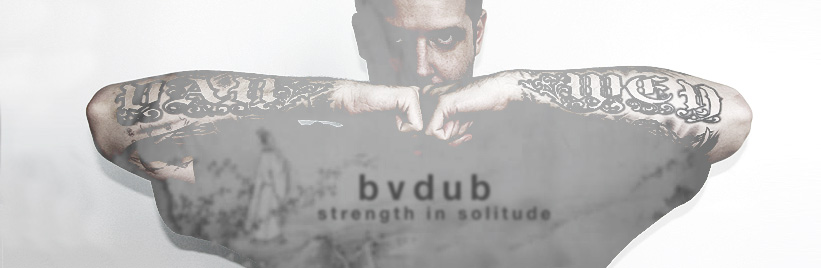
bvdub: Strength in solitude

Brock van Wey's deeply emotional ambient music has been making waves since he first started releasing tracks a few years ago. RA's Chris Mann tracks down the reclusive producer to talk about China, Krav Maga and why he's anything but dub.

Only once you've freed yourself from caring what other people think can you truly create something special. A cliché, but true: And Brock van Wey, AKA bvdub, proves the point: It took van Wey nearly 15 years after beginning his DJ career to finally issue his first production, taking a chance that the world was ready for his intimate, personal creations. He shouldn't have ever doubted himself. Despite being told that his DJing style was often "too deep," "too sad," or "too emotional," van Wey's productions have been able to take advantage of those emotions to stir up plenty of the same feelings in listeners. And, as a result, he's become one of the most important ambient artists over the past few years.

RA's Chris Mann caught up with van Wey via e-mail late last month to find out more about the Bay Area-based producer, revealing a great deal about his disillusionment with current dance music, his travels to China and his love of Krav Maga. -- Todd L. Burns

You're originally from San Francisco, but you also have spent a lot of time in China. Tell us a little about your upbringing and how you ended up in China.

I was born in San Francisco, but I grew up in Livermore, a small city about 45 minutes away. I used to think much of who I am was somehow in spite of growing up in a place like Livermore, but as I got older, I realized much of who I am is because I grew up there. Though many here in San Francisco would say it's a place that's behind the times, it's very down-to-earth, with regular people not trying to be anything they're not. I'll take that any day… a fact best proven by the "Nine Two Five" (Livermore's area code) tattooed across my neck. (Thank god, I don't have a real job.)

I had dreamed of living in China for a long time, and wound up there in 2001 when I became completely overcome with disgust and anger over what the "scene" had become, and simply couldn't take it anymore. I swore off DJing, sold off all of my 7,000 + records, and (shortly after) picked up and moved to China for several years. The only way for me to separate myself from my disappointment was to put an ocean between us, essentially. I still listened to music every day, and perhaps not surprisingly, became closer with it than I ever had before, as it was the only constant reminder of who I truly was in a place where I had basically started life over. I came back in 2004.

dubtakes

bvouttakes

Brock van Wey touched on a number of subjects throughout our interview with him. Here's but a sampling of some that we couldn't bear to leave on the cutting room floor.

On his name
The "dub" in "bvdub" has nothing to do with dub techno or dub music. "bvdub" is just an abbreviation of "BVW," my initials. It was a nickname given by a co-worker, and I started using it around 1994, long before the dub techno craze (well people didn't call it that, at least here), or before I had even heard the term "dub techno." When I started making music, I naturally used the same name I'd already been using for nearly 13 years at the time, and never really thought of the whole "dub techno" etc. connotation. Of course I can't expect everyone to know how long I've used the name, but how people think really anything I've ever made is "dub techno," I will never understand as long as I live. Just because I used a delay doesn't mean it's "dub techno."

On field recordings
Back when I was an art major for my undergraduate degree in the mid-'90s, I had a classmate who went to Africa for months, and never took one picture. All he brought back were thousands of hours of field recordings. Before then, I had never even heard of such a thing. I still remember the impact that had on me, and I have been in love with them ever since.

On never giving up on an idea
I've never started a track and not finished it. I'm far too stubborn. If something isn't working, I will leave it alone for a bit, but I won't stop until it's done. In the end, it may or may not be something other people end up liking, but it is, at that point in time, something that represents not only exactly what's in my heart and head, but also the best I can do. Luckily, there's always something new in my heart and head, and I can definitely always get better.

On soulless dance music
Music used to tell a story. It used to say something about someone's life, an experience they had, or about life in general; it was something you treasured like life itself, as it said what you wish you could say, or because you knew it meant something to the person who made it. It spoke to and from your own heart. I don't know where that went. But I wish it would find its way back. There are still some people out there speaking from the heart, but they seem to be the exception rather than the rule.

Are there distinct aspects of San Francisco and China that inspire your music differently or does it come down to your emotions as they were in a particular place in time? Are you looking at the local music scenes/traditions as well or just drawing from nature and the terrain?

I wouldn't say there are any distinct aspects of San Francisco that lend themselves to my music. In fact, I can't really imagine a kind of music that has much less to do with San Francisco than mine.

It very much has to do with emotions in a particular place and time, and at the end of the day, where you were at that time will play a big part. Sometimes it's memories of feelings I associate with it, and sometimes it's more about the feelings I once placed there, or what I hoped would happen. Much of the time what I hoped would happen never did, since, as we all know, imagination rarely becomes reality, but the beauty of hoping for something is better than actually getting it most of the time anyway.

China inspires my music very heavily, but not in the way one might expect.

How so?

For years, I dreamed of living there, taking my ideas of what it would be like, as many do, from books, films and my own idealistic flights of fancy. And, of course, it only took about three minutes of actually being there to realize I had constructed a completely false reality in my head. So it went from being a crushing disappointment, to then becoming a very real utopia that I lived and breathed every day and imagined myself being in forever, to eventually turning back again to a painful reminder that nowhere can ever be the kind of place I had dreamed… and the realization that there would likely never be a place where I truly belonged.

It's the only thing—besides the scene back in the '90s—that I had ever placed so many hopes and dreams with… and though while in China I lived some, and some forever eluded me, it will always be important as the place where, like that scene of times past, dreams and reality converged.

You first released something in 2007, but before that you were DJing and making deep house/techno and ambient mixes from as early as 1993. Tell us about the scene at the time.

The scene in San Francisco then was truly a thing to behold. I started going out in 1991, and was fortunate enough to be part of the scene here when it was at its peak, before it started to decline by the mid-'90s. It was amazing; there's really no other word to describe it. Before I went to my first rave, I was pretty much just listening to death metal, and getting into fights all the time. Then, all of a sudden, I found myself in a warehouse with thousands of people, all of whom seemed to be best friends, and within five minutes, they had made me feel like one of their best friends as well. My life was changed forever.

It was such a family back then, with everyone unified in pursuit of the same goals, and struggling in the same movement. It wasn't about who was coolest for knowing who this artist or that was, or being the only one who knew about some obscure release. It was just about wanting there to be a place where we could all escape and celebrate together, where we could feel the power and beauty of music, and appreciate its message.

When did you start DJing?

dubsided
Like most people, I instantly wanted to be more of a part of things, and daydreamed of DJing, throwing parties, that sort of thing. I messed around with DJing before that, but, by 1993, I started doing it for real, and that year put out my first mixtape in stores. I was most influenced by the few deep house and deep trance DJs at the time here that usually played in side-rooms or in the early hours of the morning, and who always stuck to their sound, even though it rarely—if ever—got them a peak-time spot.

That, to me, was music for the "true believer" crowd… the ones who soldiered through 'till 9 AM and beyond, and who were always the last ones to leave. They were the ones who often even went to parties alone, and were always there for the music. So it's no surprise that throughout the whole of my time DJing, it was always for them that I did what I did. I used to tell my friends before I even started DJing that I wanted to be the guy you heard as you were leaving in the morning when there were only like 20 people left… those muffled beats you could still hear coming out of the warehouse as you walked to your car in the gray early morning. And later, I was that guy.

Though I did have the fortune of playing some peak-time slots at some massive parties, I usually played—and felt more comfortable—in the early morning hours. In fact, probably my most memorable experience ever was playing the last set at an outdoor party, when there were literally only four people left. There were two stacks of speakers, and two people dancing in front of each stack. They never shouted, hooted and hollered, or said a word… but they truly listened, and danced every minute for hours. The five of us were completely intertwined without saying a word. I don't think you can ask for a more beautiful experience, or a better embodiment of the beauty of music.

Do you still DJ in clubs, or are you doing (or plan to do) any live sets?

I haven't played out since 2001, after my glorified hissy fit, and since I don't have records anymore, it would be pretty hard to do so. Live sets are a different story though, and I had the awesome opportunity to do my first one in March alongside Intrusion at an intimate party in Chicago. It was a lot of fun, and I'd love to do it again.

You were classically trained in piano and violin as a child. There is some piano on some tracks, especially the recent ones. Is that you playing? Some of the more recent ambient releases in particular seem to have taken on a more classical tone compared to the earlier techno tracks.

Yes, I played violin for ten years, both solo and in symphonies, and piano for about eight. The strange thing is—back when I played—I actually never liked listening to classical music, but enjoyed playing it. I wouldn't have thought it had much influence on me, but later down the line, I began to realize how much of a role it had played in my influences and how I look at music. I don't think that being classically trained makes you any more of an authority on anything, but I think—no matter what—it instills in you a greater appreciation for the composition of music, and what works with what, since you have so much experience in seeing it built from the ground up.

I don't think I could really state an overt classical influence, since I rarely listened to it. But once I started making my own tracks, I really saw it start to come out. I think even in the more techno-oriented works I've done it's definitely there. Sometimes it's more subtle than others, but I think you can spot it in pretty much everything I've ever made.

Do you sample or use your violin still?

I still have my violin, but hadn't thought of playing it on my tracks. That's a good idea. As far as the piano, my mom has a beautiful grand piano which I try to use and record whenever I can, because I don't have one of my own. Otherwise I will use both samples I've made myself on her piano over time, and samples of different kinds of pianos others have made, and rearrange them to make my own compositions. Necessity is the mother of invention, after all.

Yes
The newer tracks, particularly the latest Smallfish release, To Live, has an Asian music influence as well. What sort of Chinese and Asian music do you listen to?

I'd love to say I take influence from some really deep, obscure, classical Chinese artist, but alas, I totally love cheesy Chinese love songs and pop music. That being said, those songs have a super overt classical (Chinese and Western) influence to them, as modern Chinese music for the most part makes sure to always pay tribute to tradition, and classical Chinese music history. Plus, a whopping majority of Chinese pop music that appears to be sappy love songs if you don't understand the lyrics are actually extremely sad, and are full of despair, loneliness, heartbreak and betrayal. All my favorites.

You also just released a new single on Echospace with an Intrusion remix. How did you come to meet Steve Hitchell?

One day I was (pleasantly) surprised to receive an email from Steve, telling me that he had several of my releases, and really liked them. It was really something to hear from him, as I had admired his work for quite some time. I thought it was really cool that he took a moment to reach out like that. We had some emails back and forth, and started to realize that our history with electronic music, from the rave days, to DJing, to throwing parties, to pretty much everything really, was frighteningly similar.

He struck me immediately as a really down-to-earth, genuine dude, and over time we had developed a sort of email friendship, and I asked him if he would be open to listening to something I had made. He said he was down, as long as it was something truly personal made from the heart, not just a bunch of tracks thrown together that I wanted to get signed.

In the last year or so that I've gotten to know Steve, we have become very good friends, and it's an honor to not only get to cooperate with him, but to call someone a friend who is quite frankly one of the nicest, most down-to-earth, sincere and true people you could ever meet. It's very heartening to know that such people still exist, and it's inspired me anew in a way I haven't known since those days as a rave kid.

"A friend once said to me that this scene
is a tough place for someone who wears
their heart on their sleeve. He's right."


What can you tell us about the album that resulted?

Well, after that, I sat down and made the entire album from start to finish, specifically for him and Echospace, having no idea if he would like it or hate it. I actually had no conceived idea of what I even wanted it to be like… I just sat down and poured my heart out, and let it be what it may. The end result was hands-down the most beautiful collection of music I had ever made, and also, surprisingly enough, the most hopeful (not usually my forte).

I was a little nervous in sending it to him, as it was completely unlike anything that had been on Echospace, or anything I had made before, and I honestly thought he was going to tell me I was insane. But the reply I got back was the exact opposite. He loved it as much as I did, and I could tell it meant to him what it did to me.

Not only did he offer to put it out on Echospace, which was already amazing enough, but he then proceeded to make an entire interpretive album to accompany it, in which he re-interpreted all the tracks to form a companion album and journey. So the release will contain both my original works and his interpretations, each their own album, with each standing completely on their own, but also going together like they were born to be so.

You mentioned to me that you have more full-lengths coming out this year. What can you tell me about them?

One will be on Somnia, a U.S. label, and one is on Distant Noise from the UK. They are both limited edition, personally run labels who share the same vision I do, so it's really great to be able to be involved with both of them. The Somnia one, One Last Look at the Sea, is a mix of deep techno, ambient techno and ambient, whereas the Distant Noise one, Songs for a Friend I Left Behind, is all ambient. Both were conceived and worked on as entirely separate projects, and both made specifically for those two labels. When I sit down to make a full-length album, it's always from the ground up, purely for that purpose, and never comprised of pre-existing tracks. And the order of the tracks is always exactly the order they were made, as one track inspires the next, and so on. I think that way if you hear it, you can get the full story how it was supposed to be told.

Quietus

Why I started Quietus

Quietus came about from frustration. (Surprise.) Of course I had always wanted to start my own label, but like most I didn't really know how to go about it, and was afraid to take those first steps. Then two things happened in the course of a week that made me buck up and do it:

First, my dear friend Mike (Remote_) had relayed a story about how someone had called one of his favorite pieces he ever made "too self-indulgent." This made me furious. How can someone's personal expression through music be deemed "self-indulgent?" Like it's somehow negative that he made it how he wanted to, or according to his feelings? That's what music is supposed to be. It's not supposed to be made in accordance to what you think everyone else will like. Otherwise, they can make it themselves.

Second, Sven (Quantec) had some tracks turned down by a label for being "too deep." To me, they were two of the best, most beautiful tracks he had ever made, and I knew he felt the same. I knew there needed to be some way for him, me, and others to put out their deepest, most personal music without having to worry about it ripping up the dancefloor, selling thousands of copies, or whatever.

To me a small-run, personal label was the only way to do that. So I started Quietus, which is a very small-run CD-R label that I do every single thing by hand for, to keep everything as personal as possible. I take the photo for both the CD label and the front cover, always specifically and only for that release, with the release in my headphones while I take it, so audio and visual all converges on that moment. The entire concept was centered around the tactile photo (the actual developed photo, not a printed version) being a partner to the music, like a kind of musical postcard, to bring me, the artist (if it's a release that's not from me), and the listener together for those moments. So much of the musical experience today is so hands-off, and I think it's contributed to it being seen as more and more disposable—which is sad beyond words.


You described the recent 20-minute epic To Live on Smallfish as your most personal record. What is the story behind this single? It's more classical and has a more complicated arrangement than any of your previous tracks.

I think the reason "To Live" comes across so differently from most, if not all of my other tracks, and has a more complicated arrangement, is because rather than my usual method of sticking to one main emotion per track, it is my attempt at summing up the entirety of a life, and what it means to live, in just under 21 minutes. And we all know life is complicated. Also, I think it's hard not to start to lean in a classical direction when making music that deals with philosophical issues or life itself. Life itself was pretty much what classical music was all about… and those who made it were the kings of summing up what it meant to live and be part of this world, using only abstract forms of expression through the sound made from instruments. If that's not the basis for what we're all doing, I don't know what is.

I made the piece for Mike at Smallfish purely for that release, and I think the reason I was able to pour my heart out so freely on it is that I know he is one of the few people in the world who truly understands every facet of what I'm trying to say. He has become a very dear friend of mine, and I wanted to make something for him that I hoped he would feel as I did, but also something that would show the respect and love I have for him, and his true dedication and contribution to the world of this music we both love like life itself.

You always seem to be striving to say something personal with your music and with Quietus. Does it worry you that maybe your career or success might make it difficult to remain personal since you already seem to have had a bad experience with the rave scene?

Well my experience with the rave scene was at one point the best of my entire life. But what it became later on definitely amounted to a bad experience, to say the least.

I don't think success makes it difficult to be personal, but I think being personal makes it difficult to be successful. Even with DJing I let my inability to separate my personal feelings from politics eventually cause my own demise. And letting the world hear your own music, and every facet of your heart and soul, is much more personal and potentially fraught with disaster. But that's the name of the game. It's all about showing a part of you, a part of your heart and soul, and hopefully some who hear it feel the same way you do, and it creates that connection that is the ultimate beauty of music. Hell, even if they don't feel it at all, that's still part of the beauty, as it just shows you how complicated what speaks to us really is, and makes it all the more special when someone does feel it.

Mike (Remote_) said to me once early on that this scene is a tough place for someone who wears their heart on their sleeve. He's right. I found that out the hard way long ago. But all you can do is continue on in the way you think is right, and hope that you make a positive mark on the world. Remaining personal will never be difficult for me, because it's all I know. And I wouldn't trade that for all the notoriety or success in the world.

You study Krav Maga, a type of kickboxing and often participate in "real" fighting. How do you liken Krav Maga to dancing? Is there any rhythmic basis or any creative impulses that you have taken for your music?

I studied Krav Maga for many years, which is a self defense system developed by the Israeli Defense Forces, and at its higher levels deals more military-related hand-to-hand and disarmament scenarios. But a large part of the system is, quite frankly, knowing how to fight.

Though it was through Krav Maga that I learned how to fight, a lot of it deals more with self-defense, and later on I found I like the actual fighting much more. So for the last two years I have exclusively trained Muay Thai (Thai kickboxing), which is purely a ring sport (in its modern form, anyway), and which is much more of an art form (well at the hands of those who are truly artists... I rely mostly on brute force and stubbornness). Whereas Krav Maga is mostly about brute force, Muay Thai is about technique and rhythm, both yours and your opponents, while certainly not casting aside the brutality. I guess if I had to liken one more to dancing it would be Muay Thai, but I would hope it's not too close, because I'm a horrible dancer.

Do you look for the same catharsis there as you do in the music, even though they are opposite physical extremes?

Though both music and fighting are extremely cathartic, it's in very different ways. Actually music is a strange mix of being cathartic and only making things worse, as it just makes me obsess even more about a particular emotion for the whole time I'm making a track. But fighting is the exact opposite. I don't care what's going on in the world, for that time you're in the ring, absolutely nothing else enters your mind but what's happening at that exact second. By the time you're done (or sometimes, by the time you wake up), that catharsis lasts for hours and hours. It's like a drug.
Words / Chris Mann
Published / Wed, 24 Jun 2009

comment 15 Comments


Features


Other recent features
DJ Bone: True to da rootsSebo K: Safety firstBreaking through: Sleigh Bells

About  
RSS feeds  
Get involved  
Submit event  
Copyright © 2009 Resident Advisor Ltd.
All rights reserved. Terms & Privacy.